

The spine is a fascinating network of bones, discs, facet joints, ligaments, spinal nerves and muscles, all combined and connected in an incredibly complex way to provide both stability and wide range of movement. We often overlook, however, that our spine is actually a series of joints, joints that sometimes need help functioning as they are intended.
The individual vertebrae are separated by rubbery discs that act as shock absorbers, allowing the bones to glide over each other in order for the spine to bend, twist, and remain stable. These discs are composed of an outer, fibrous ring containing multiple layers of collagen called the annulus fibrosus. The ring is filled with a gel-like substance called the nucleus pulposus that provides cushion for our spine.
Low Back Conditions
The outer ring of the disc can sometimes become damaged from injury, improper lifting, poor posture, or repetitive motions. Genetic conditions and a sedentary lifestyle also can weaken supportive spinal muscles, increasing vulnerability of the spine. The terms “bulging” and “herniated disc” are sometimes used interchangeably because they both entail damage to a disc that presses on a nerve causing pain in the back, legs or arms. However, the conditions differ with extent of damage to the disc.
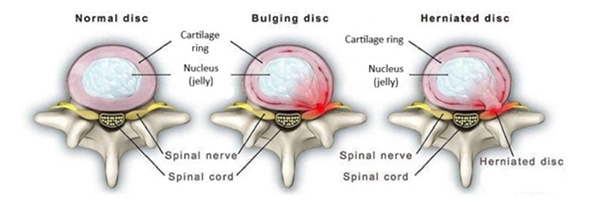
Degenerative Disc Disease is not actually a disease. It is a condition resulting from mechanical dysfunction of the vertebrae. The condition is classified according to its dysfunction.
- Bulging disc. A bulging disc results when the jelly-like nucleus of the disc pushes against the outer, fibrous layer causing it to push on the spinal nerve.
- Herniated disc. Herniated Nucleus Pulposus occurs when the nucleus, the disc’s inner core, protrudes through a tear in the annulus, the outer ring of the disc, compressing or irritating the spinal nerve root, causing radiculopathy.
- Slipped disc. Both a bulging disc and a herniated disc are often referred to by a more casual term “slipped disc.” This term is most frequently used for spondylolisthesis, which is a condition in which a vertebra slips forward over the vertebra below.
- Disc degeneration. As a normal process of aging, the discs begin to wear down. Sometimes the discs wear away completely over time. The bones rub against one another, causing the pain and stiffness of osteoarthritis. After age 40, most people have some disc degeneration, but not always with pain. https://www.arthritis.org/diseases/degenerative-disc-disease
Treatment for Discogenic Low Back Pain
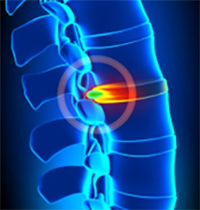
Pain is our body’s way of telling us it needs attention. When injury occurs, our body sends healing cells to repair damaged tissue. This process results in inflammation, a natural part of the healing process. As conditions become chronic, however, out of control inflammation is no longer beneficial. Your body needs some help in supplying healing cells and modulating constant inflammation.
Although 65% of individuals experience a form of low back pain at some point in their lives, traditional medicine often continues to treat spinal conditions with corticosteroids, a substance that has been shown definitively to both stop the natural healing process and to damage joint tissue. Corticosteroid injections work by reducing inflammation, thereby alleviating pain. However, the use of high-dose corticosteroids comes with potential adverse effects. Learn more.
Surgery may be necessary in specific cases of spinal dysfunction, but involves higher risk, longer recovery, and irreversible structural changes. Surgery is rarely the first option.
When inflammation stops, healing stops also!
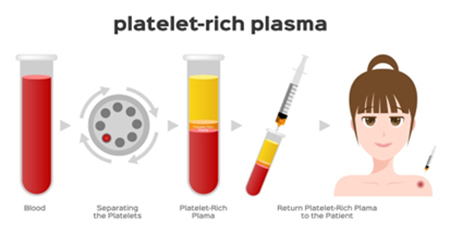
Platelet Rich Plasma (PRP) and Degenerative Disc Diseases
A key reason that damaged discs do not heal well is their structure. The outer, fibrous ring (the annulus fibrosus) has poor circulation because of its dense, collagenous tissue. In order for regeneration to occur effectively, sufficient nutrients, natural growth factors, and stem cells must be present. Collagenous tissue, however, inhibits blood flow that supplies these healing cells.
Regeneration of cells also replaces lost nucleus pulposus cells that compose the gel-like substance creating the cushion for your spine. Studies by Chen, W.H. et al concluded:
By focusing on the root cause of pain rather than masking symptoms, PRP provides a long-term solution to Discogenic Low Back Pain.
Stem cells and nutrients in surrounding tissue can become depleted due to chronic or severe injury, arthritis, or poor cellular health. When availability of stem cells and necessary healing factors do not keep pace with healing demands, the body needs a little help. Learn more.
If our bodies heal themselves, why is PRP sometimes needed?
- PRP condenses platelet cells to magnify their healing capacity, accelerating and enhancing the healing process.
- Plasma, the liquid portion of blood, acts primarily as a transport medium for blood cells, nutrients, and metabolic waste products.
- Collagenous tissue, such as tendons, ligaments and cartilage, have extremely poor blood supply, causing these tissues to heal slowly and often incompletely.
- Platelets stimulate activation of localized stem cells and promote a healing response in surrounding tissue.
Damaging Effects of Cortisone Injections
Cortisone injections are effective in reducing pain because they temporarily reduce the inflammation causing the pain. The problem is that inflammation is the body’s method of healing. When inflammation stops, healing also stops. Certainly, excessive inflammation is to be avoided, but long-term treatment by cortisone and NSAIDs is not the answer. Procedures that address the root cause of inflammation give better long-term results without the side effects associated with synthetic substances. Learn more.
Use of high-dose corticosteroids comes with several potential adverse effects:
- Joint and Tissue Damage: Repeated corticosteroid injections can lead to the weakening of tendons, cartilage, and bone. This can result in joint instability and an increased risk of tendon ruptures.
- Osteoporosis: High doses of corticosteroids can accelerate bone loss, increasing the risk of fractures and osteoporosis.
- Infection Risk: Corticosteroid Injections can suppress the immune system, potentially leading to infections such as septic arthritis.
- Endocrine Disruption: Corticosteroids can interfere with the normal function of the adrenal glands, potentially causing hormonal imbalances and conditions such as Cushing's syndrome.
- Short-Term Relief: While corticosteroids can provide rapid pain relief, this effect is often temporary, necessitating repeated injections and increasing the risk of cumulative damage.
Where do I start?
The first step in addressing back pain involves obtaining an accurate diagnosis from a specialist. If not treated properly, early-stage symptoms can exacerbate pain or cause permanent nerve damage. If you are experiencing some of the symptoms below, Dr. Minotti can help you navigate a diagnosis and treatment plan.
Common Symptoms of Degenerative Disc Disease
- Low-grade, ongoing, or chronic pain around the degenerating disc that occasionally erupts into more severe pain
- Pain with bending or twisting the spine, or when lifting heavy objects
- A feeling that the back is unable to provide support, or that it may “give out” or lock up, making movement difficult
- Pain that radiates down the leg

Once you have a confirmed diagnosis, Dr. Minotti will discuss whether PRP is the best option for your individual condition. Opposed to surgical intervention, regenerative injections are designed to preserve and support native tissue. By targeting the painful spinal structures, many patients experience functional improvement and reduced pain as healing progresses. PRP can help patients delay or avoid surgery and, also, helps to reduce reliance on medications.
What does the research say?

Chen W-H, Lo W-C, Lee J-J et al. Tissue-engineered intervertebral disc and chondrogenesis using human nucleus pulposus regulated through TGF-beta1 in platelet-rich plasma. J Cell Physiol. 2006;209(3):744-754. doi: 10.1002/jcp.20765. https://onlinelibrary.wiley.com/doi/10.1002/jcp.20765
SUMMARY
With aging, intervertebral disc (IVD) degeneration often originates from the nucleus pulposus (NP) and leads to IVD destruction. Chen and colleagues examined the role of growth factor-beta1 (TGF-beta1) in platelet-rich plasma (PRP) on disc regeneration. PRP promoted regeneration of nucleus pulposus cells. PRP growth factors can act as a growth-factor cocktail to promote proliferation, differentiation of NP cells.
***
Kawabata S, Akeda K, Yamada J, et al. Advances in platelet-rich plasma treatment for spinal diseases: a systematic review. Int J Mol Sci. 2023;24(8):7677. doi: 10.3390/ijms24087677. https://www.mdpi.com/1422-0067/24/8/7677
SUMMARY
This comprehensive review article from Kawabata et al examined the current literature for basic research and emerging clinical applications of platelet-rich plasma (PRP) for treating spinal diseases. PRP clearly showed efficacy in the treatment of degenerative disc disease al... PRP is considered safe and effective therapy for disc disease.
***
Zhang J, Liu D, Gong Q, Chen J, Wan W. Intradiscal autologous platelet-rich plasma injection for discogenic low back pain: a clinical trial. Biomed Res Int. 2022:9563693. doi: 10.1155/2022/9563693. https://onlinelibrary.wiley.com/doi/10.1155/2022/9563693
SUMMARY
Lumbar intervertebral disc (IVD) degeneration has traditionally been treated using conservative (rest, physical therapy, anti-inflammatory drugs, etc) and/or surgical (IVD fusion to eliminate movement between discs) methods. Zhang and colleagues examined the effect of platelet rich plasma (PRP) therapy on the pain and function of patients with discogenic low back pain (DLBP). They found significant improvements in pain and function at week 48 after a single intradiscal PRP injection. Overall, intradiscal injection of PRP was safe and effective in patients with DLBP.
The natural force in each of us is the greatest healer of all -Hippocrates